Please turn your device to portrait.


BeA Group APAC’s Craig Stephens and Nick Hall explain why integrated fastening systems, automation and repeatable manufacturing processes are becoming critical to the next generation of offsite construction.
partner content
Australia’s offsite construction sector is investing in increasingly sophisticated manufacturing equipment, but according to BeA Group APAC, one of the industry’s greatest challenges is not acquiring automation. It’s learning how to use it properly. (main image: Craig Stephens (left), General Manager – APAC, and Nick Hall, Sales – APAC, at BeA Group, discussing fastening technology and automation in offsite manufacturing at Offsite26.)
German-headquartered BeA Group is a global supplier of industrial fastening tools, fasteners and automated fastening systems, with applications across timber construction, prefabrication and manufacturing. BeA’s autotec industrial solution specialises in fastening technology integrated into automated production lines and robotic machinery, including systems used to manufacture timber wall panels, roof trusses and other prefabricated building components.
Speaking with Built Offsite at the prefabAUS Offsite 2026 conference, Craig Stephens, General Manager – APAC, and Nick Hall, Sales – APAC, at BeA Group, discussed the development of industrialised construction and the operational changes needed to achieve greater manufacturing productivity.
Stephens says the technological distance between Australia’s offsite factories and some overseas operations remains considerable.
He points to South Korea, where manufacturers such as Space Factory are pursuing highly automated production of prefabricated building components, as an example of how far industrialised construction can progress.
“Over the last five years, we’ve seen the industry progress towards highly automated manufacturing with minimal human intervention,” he says.
Although Australian manufacturers have made progress, Stephens believes the distinction between conventional construction conducted indoors and genuine industrialised production deserves closer examination.
For him, the transition begins when production moves beyond handheld tools towards equipment integrated into machinery, progressing from basic framing lines to robotic manufacturing systems.

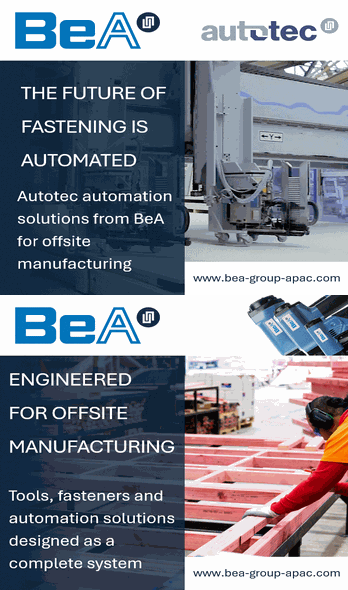
BeA Group’s Autotec fastening systems at Space Factory in South Korea combine robotic arms and specialised coil nailers to automate timber frame assembly, with fixing possible from virtually any angle.
From repetitive framing to integrated production
Stephens identifies wall framing and roof truss manufacturing as the traditional entry points for automation.
Wall framing and roof truss production remain the most common entry points for automation because they are highly repeatable manufacturing processes. As manufacturers move into sheeted panels, volumetric construction and fully finished modules, the complexity of fastening systems and production integration increases significantly.
For BeA, that progression changes how fastening systems are specified and integrated into production lines.
Unlike many fastening suppliers who focus on either tools or consumables, BeA approaches offsite manufacturing as an integrated fastening system.

As manufacturers evolve from manual assembly through to highly automated production, fastening requirements change significantly. A production line may include hand-held fastening tools for assembly and rework, pneumatically driven tooling for semi-automated stations, and fully integrated fastening systems operating within automated manufacturing cells. BeA supports that progression by providing fastening solutions that can scale alongside manufacturing operations, reducing the need to change technology platforms as production volumes increase.
BeA supplies solutions across that entire spectrum, combining fastening tools, fastening technology, engineered fasteners and automation expertise through a single platform.
Hall argues that the benefits extend beyond simply increasing the number of fasteners installed per minute.
“The challenge isn’t simply driving more nails or staples into timber. It’s ensuring the fastening process operates consistently across manual, semi-automated and fully automated production environments.”
For automated applications, BeA’s autotec systems are designed to integrate with production machinery and robotic systems, while BeA’s industrial fastening tools and engineered fasteners support the wider manufacturing process. By designing fastening tools, automation systems and engineered fasteners as a complete system, manufacturers gain greater reliability, more predictable performance and fewer production interruptions.
“The fastener is often one of the lowest-cost components in the process, but it’s also one of the most critical,” Hall says. “A fastening failure can stop an entire production line.”
For manufacturers seeking to increase production volumes, BeA argues the greatest gains are achieved when fastening technology, automation and consumables are considered together rather than as separate purchasing decisions.
Hall argues that the benefits extend beyond simply increasing the number of fasteners installed per minute.
“It’s not just about speed. It’s also about quality, repeatability and predictability. That means less downtime and greater efficiency,” he says.
Importantly, automated fastening systems do not operate independently of the machinery controlling the manufacturing process.
Stephens explains that BeA’s tools interface with the programmable logic controllers (PLCs) used by machinery manufacturers.
The machinery determines the position and timing of each fastening operation, while BeA’s systems incorporate sensors and monitoring functions capable of identifying missed firings or depleted fastener magazines.
These signals can stop production equipment when an issue is detected, preventing an interrupted fastening operation from going unnoticed.
This relationship between machinery control and fastening technology illustrates why industrialised production depends on coordination between systems rather than automating individual tasks in isolation.

The cost of underutilised machinery
One of Stephens’ more pointed observations concerns manufacturers investing substantial sums in equipment without fully exploiting its capabilities.
“The biggest issue we see is manufacturers underutilising the equipment they’ve purchased. Some are slow to adapt and prefer to keep doing things the way they’ve always done,” he says.
He suggests this reluctance can extend to unnecessary manual intervention in processes designed to operate automatically.
Stephens also identifies the importance of relatively inexpensive components within multimillion-dollar manufacturing installations.
“You might invest one million, two million or even $20 million in machinery, but one of the cheapest components in the process — a nail, staple or screw — can stop the entire production line if it doesn’t work properly.”
The challenge therefore extends beyond reducing labour requirements. It includes developing the operational knowledge and confidence needed to allow automated equipment to perform as intended.
Stephens says manufacturers willing to adapt quickly are also placing greater demands on equipment and technology suppliers.
This is particularly apparent in volumetric modular construction, where manufacturers are seeking new tooling capabilities to accommodate increasingly complex production requirements.
Standardisation without identical buildings
Looking ahead, Stephens believes one of the greatest opportunities for offsite construction lies in standardising manufacturing processes rather than standardising building designs.
“The more we have to reposition tools, the slower production becomes. Our fastening equipment can already operate faster than the machinery can reposition it,” he explains.
For designers and manufacturers, this presents an opportunity to increase productivity through repeatable production methods while still delivering buildings with different appearances, layouts and finishes.
“Buildings don’t have to look the same. That’s where architects and engineers come in. We can standardise the manufacturing process while still delivering different appearances and finishes,” Stephens says.
For the offsite sector, the challenge is not simply investing in more automation, but designing products and processes that allow manufacturers to fully utilise the technology already available.
The future of offsite manufacturing is not defined by robotics alone. Success depends on how effectively manufacturers integrate automation, fastening technology and production processes into a single, repeatable system. As Australia’s offsite sector continues to mature, manufacturers that treat fastening as a strategic element of production, rather than a commodity purchase, will be best positioned to improve productivity, quality and scale. For BeA, the future of offsite manufacturing will be built on integrated systems where automation, fastening technology and engineered fasteners work together to deliver repeatable manufacturing outcomes.
Find BeA Group HERE