Please turn your device to portrait.

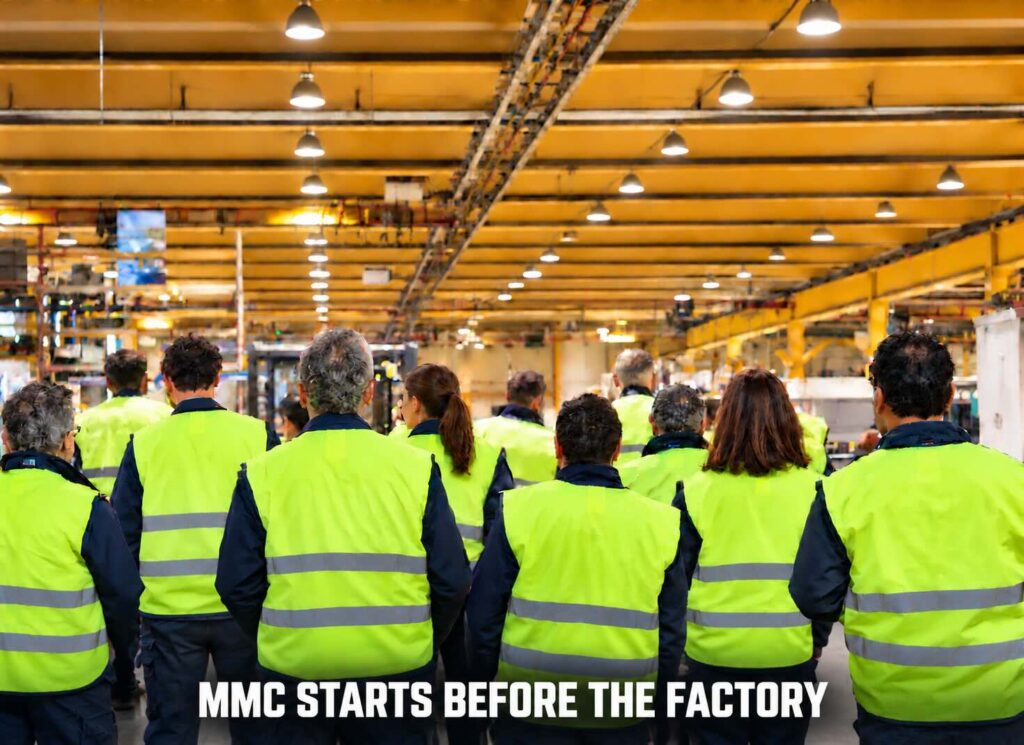
Designers, developers and engineers need to know how to plan buildings for manufacture from the outset, says BuildSkills Australia’s Robert Sobyra. He argues that the priority is strengthening these capabilities, with existing manufacturing training already providing a foundation for factory roles.
Part one of a two-part series based on a conversation between Robert Sobyra and Built Offsite publisher Michael Dolphin. This instalment examines the workforce and skills implications of MMC. Part two will explore how government procurement can support sustained demand for industrialised construction.
Australia’s shift towards modern methods of construction (MMC) is putting greater responsibility on the people who design buildings and decide how projects will be delivered. For Robert Sobyra, that is where the most urgent workforce development effort belongs.

In conversation with Built Offsite publisher Michael Dolphin, Sobyra, General Manager – Research and Strategy at BuildSkills Australia, says the industry needs to examine how industrialised construction changes the work itself.
“It’s really the front of the pipeline where we need to be placing our attention,” he says.
His comments expand on Modern Methods of Construction: Workforce and skills implications, a report prepared by BuildSkills Australia, the Manufacturing Industry Skills Alliance and Skills Insight. It identifies professional and paraprofessional capability as the immediate training priority, while finding little justification for a dedicated MMC apprenticeship.
The central question, Sobyra explains, is where human capability could constrain the industry’s development.
“Where are the labour bottlenecks most likely to be? Where do we need skills uplift? Where don’t we need skills uplift?”
For developers, architects and engineers, the implications begin with project conception. Manufacturing requirements need to inform the design and delivery strategy early enough to influence the building.
“They’re the ones who really need the capability uplift,” Sobyra says of the designers, development planners, architects, engineers and consultants shaping those decisions.
Moving expertise earlier in the process
Conventional construction draws heavily on tradespeople resolving and executing work on site. In a mature industrialised model, more of that expertise is applied through design, engineering, manufactured components and controlled production processes.
“The application of human expertise moves into the supply chain, moves into the manufactured inputs,” Sobyra says.
That changes what project teams need to understand. Design decisions must account for how components will be produced, transported, assembled and integrated. The report consequently places greater emphasis on upfront documentation, production planning, logistics and coordination.
During the conversation, Dolphin raised the role of BIM and digital information in connecting these activities. Sobyra distinguishes digital tools from the production model itself, while acknowledging their importance to making it work.
“You don’t realise the benefits of MMC without digitalising the production process,” he says.
His point is that digital capability needs to serve an understanding of manufacturing and assembly. Software proficiency alone cannot establish how a project should be organised.
“Digitalisation is a thread that runs through that, but it is not … the fabric.”
The underlying test remains productivity: whether the production model allows more buildings to be delivered with the labour available.
“The whole point of any productivity enhancing technology is to reduce the labour content that you need to produce a unit of output,” Sobyra says.
Building on existing manufacturing skills
For factory workers, Sobyra sees a different training requirement. Many of the underlying capabilities already exist within manufacturing qualifications and production occupations.
“Those pathways are already well serviced by the vocational education and training system, but it’s not within the construction pathway. It’s over in the manufacturing and production pathway.”
Employers then need to train workers in their own machinery, processes and quality requirements. A qualification provides the foundation; workplace learning establishes how that capability is applied within a particular operation.
“So you need to learn, you know, the Modscape way, if I can use an example,” he says.
Companies consulted for the report were already investing in this internal training.
“Every new worker into that facility needs to be inducted and trained in their particular way of working.”
For Sobyra, this supports a targeted response that strengthens existing pathways and structured workplace learning.
“That does not require a new trade. It does not require any new occupation.”
Two pathways into construction
Sobyra expects traditional construction and industrialised production to develop alongside one another, with different occupational requirements.
He draws a comparison with furniture production: a craftsperson making an individual piece and a worker on a factory production line contribute to the same broad market through different skills and processes.
Construction, he argues, will continue to need both.
“We will always have the bespoke track because there will always be renovations and retrofits,” he says.
“There will also always be people who want to have their house hand-built by a craftsperson.”
At the same time, defined manufacturing roles could make the sector accessible to people for whom a full trade apprenticeship is impractical.
“What MMC operations often provide is a way into the industry.”
The report retains an essential role for licensed trades, builders and certifiers at regulated interfaces, commissioning and complex site conditions. Its argument is that training should reflect the tasks workers actually perform as production changes.
For project leaders, that brings the discussion back to the earliest decisions. Factory capability can only be used effectively when the project has been conceived with manufacturing in mind. As Sobyra puts it, the people deciding how a building will be delivered need to approach that task “from first principles”.
Find BuildSkills Australia HERE