
Please turn your device to portrait.

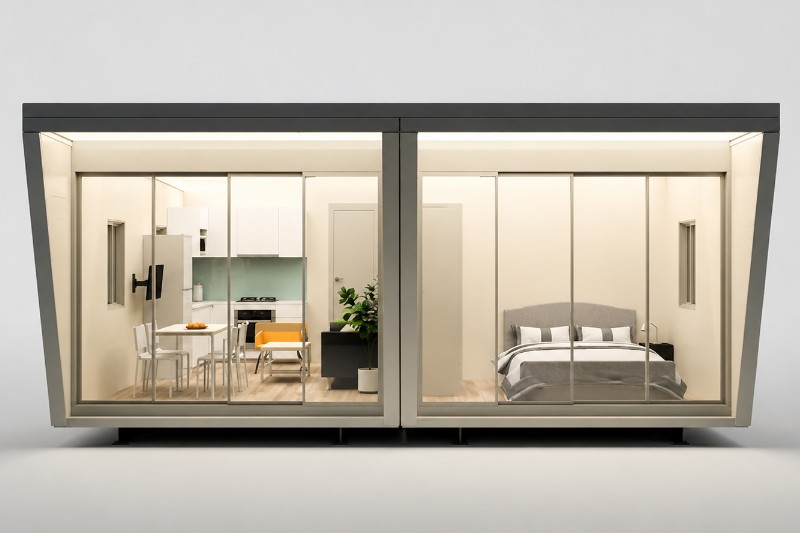
A UK proposal to replace hotel accommodation with modular homes raises a broader question for Australia: could governments reduce long-term housing, health and social service costs by investing in relocatable housing assets instead of recurring emergency accommodation?
A proposal in the UK to use modular housing instead of hotels for families in temporary accommodation raises a broader question for governments: should emergency housing continue to be treated as an operating expense, or could part of that funding be invested in housing assets that retain long-term value? (Image credits: Wild Modular, NSW.)
Housing provider Places for People has called on English councils to use vacant public land for modular housing, arguing the approach could reduce reliance on hotels and bed-and-breakfast accommodation while providing families with more stable housing.
The organisation says it has already delivered 20 modular homes with Bristol City Council and estimates that moving a household from emergency accommodation into one of its modular homes could save councils up to £24,540 a year (about AUD $47,000). It has also called for part of England’s £2.8 billion annual temporary accommodation bill to be redirected into modular housing.
While those savings require independent verification, the proposal highlights a much larger policy question.

Looking beyond construction costs
Comparing the nightly cost of a hotel room with the purchase price of a modular home only tells part of the story.
Housing instability often generates costs across multiple government portfolios, including hospitals, ambulance services, mental health care, policing, courts and social services. Stable housing can reduce demand on many of these services, meaning the financial benefits may extend well beyond housing budgets.
An Australian study of more than 2,100 people attending homeless hostel health clinics found hospital costs totalled AUD $548 million over 13 years, with a median hospital cost of more than AUD $81,000 per person.
Similarly, an AHURI review (pdf) of Housing First programs found secure housing can reduce hospital use and interaction with the justice system, particularly for people with complex needs, although it noted that housing alone is not enough and ongoing support services remain essential.
A different way of measuring value
The UK proposal also shifts the discussion from operating expenditure to capital investment.
Money spent on hotel accommodation provides shelter but leaves governments with no asset. Investment in modular housing creates a building that can remain in service, be maintained and potentially be relocated or repurposed.
That does not automatically make modular housing the cheaper option.
A proper economic assessment would still need to include land servicing, planning, financing, maintenance, occupancy rates, support services and the residual value of the asset. It also remains unclear whether Places for People’s claimed savings include these costs.
The Australian opportunity
Australia faces many of the same pressures as the UK, including rising expenditure on homelessness services, increasing demand for temporary accommodation and long waiting lists for social housing.
The question for governments is not simply whether modular homes can be delivered faster. It is whether investing in modular housing can reduce long-term expenditure across housing, health, justice and social services while creating assets that remain in public ownership.
If modular housing can replace years of recurring emergency accommodation costs with durable, relocatable dwellings, the economic case extends well beyond construction.
Find Places for People HERE