Please turn your device to portrait.


As its Sydney modular apartment programme gathers pace, Freecity says earlier rental income, rather than lower construction costs, is driving the commercial case for volumetric construction.
Modular construction has long been promoted as a way to build housing faster and cheaper. Freecity, the Sydney developer assembling high-rise apartment buildings from modules manufactured in China, is demonstrating the first proposition. The second remains less certain. (main image: Freecity’s Herring Road project puts factory-built housing into practice.)
In the first of a two-part Built Offsite series examining the University of Melbourne’s Scaling MMC in Australia workshop, we consider Freecity’s experience of delivering high-rise volumetric modular construction, including the commercial opportunities, technical complexities and risks involved. Part Two examines the tensions surrounding imported modular buildings and the implications for Australia’s domestic manufacturing sector.
At the workshop on 16 October, Freecity offered a candid account of what it takes to make volumetric modular construction (VMC) work at scale.
Its message was commercially pragmatic. The advantage isn’t necessarily a cheaper building, but one that begins generating rental income sooner. Achieving that advantage, however, requires substantial investment in design, engineering, manufacturing coordination and logistics well before construction reaches the site.
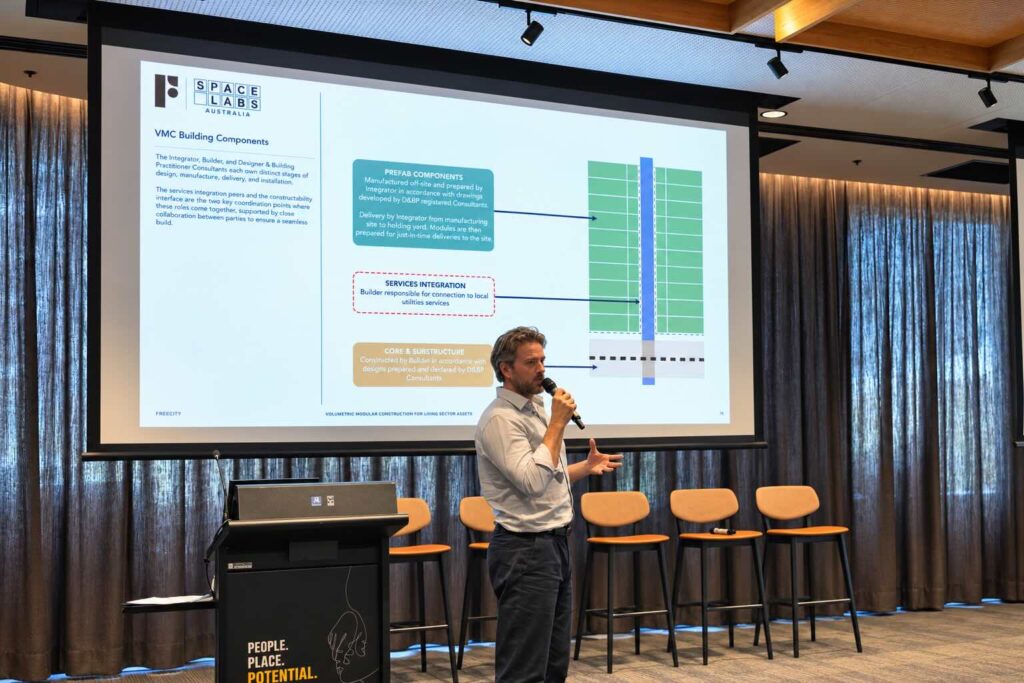
Speaking at the Scaling MMC in Australia: Accelerating Build-to-Rent and Housing Delivery workshop, Freecity’s Filomena Beshara, Development Manager, ESG and Innovation Lead, and Sam Lewis, Modular Director, outlined the opportunities and complications emerging from the company’s expanding development programme.

Their presentation followed University of Melbourne research (pdf) commissioned by Freecity, which identified financing, taxation and regulatory barriers constraining the wider adoption of VMC in Australia’s build-to-rent sector.
While that research examined what governments and financial institutions could do to support modular construction, Freecity’s presentation offered something more immediate: the experience of actually delivering it.
Building faster doesn’t necessarily mean building cheaper
At Herring Road in Sydney’s Macquarie Park, Freecity is delivering a 20-storey, 528-room purpose-built student accommodation development using fully fitted volumetric modules manufactured in China.
The modules are shipped to Australia and installed around a conventionally constructed reinforced concrete core. Each arrives with its façade already attached, substantially reducing the amount of external finishing required on site.
Beshara said the project had reached an installation rate of approximately 33 modules a week, equivalent to an entire residential floor. On productive days, around ten modules can be positioned and connected to the building.
That construction pace is impressive, but it does not tell the entire story.
The speed achieved during installation follows extensive preparation, including design coordination, factory testing, engineering approvals, international shipping and logistics planning. Much of the construction effort has effectively been transferred to an earlier stage of the project.
Nor is Freecity suggesting that the methodology automatically delivers a lower construction cost.
“Is it cheaper? At this stage, I’m not convinced it is,” Beshara said.
Instead, the financial case rests heavily on the ability to shorten the overall development programme.
“The potential right now is really about shrinking the program and getting access to revenue-generating assets earlier.”
For build-to-rent, co-living and student accommodation developments, that distinction matters. Unlike apartments constructed for individual sale, these properties are generally retained as income-producing assets. Bringing forward occupancy can improve the economics of a development even where the initial construction cost is comparable to, or higher than, conventional methods.
Freecity has a development pipeline exceeding 6,000 units, primarily across Sydney, including planned projects at Rouse Hill, Parramatta and Sydney Olympic Park.
The scale of that pipeline is central to its strategy. Repetition across multiple projects creates opportunities to standardise components, refine construction methodologies and recover the investment associated with developing a modular building system.
Yet the company is also conscious that repetition need not mean architectural uniformity. Beshara pointed to its use of differing façades, apartment configurations and building forms, including the terracotta façade at Macquarie Park, as evidence that modular construction does not necessarily limit design.
The more difficult question is how that design flexibility can be reconciled with the standardisation on which manufacturing efficiency depends.
The risk doesn’t disappear — it moves
Lewis, whose experience includes major modular developments in the United Kingdom, was particularly direct about the technical and logistical challenges.
His central argument was that modular construction does not eliminate risk. It shifts that risk to an earlier stage of development, when decisions about design, manufacturing, procurement and compliance must be made.
That has significant implications for developers and builders accustomed to resolving elements of a project progressively during conventional construction.
One example is dimensional tolerance.
Factory-produced modules can be manufactured to tolerances of approximately 1–2 mm. A reinforced concrete core, however, may experience dimensional variations of around 20 mm over the height of a substantial building.
Reconciling those differences requires careful coordination of structural connections, locating pins, façades and the interfaces between factory-produced and site-built elements.
Lewis described tolerance management as one of the least glamorous but most consequential aspects of high-rise modular delivery.
Freecity uses predominantly bolted structural connections and undertakes full-scale prototyping and test stacking before commencing production.
For Herring Road, a prototype was assembled at Villawood, allowing consultants and contractors to examine structural connections, building services and façade interfaces before modules entered mass production.
Such work can take place 18 months or more before the first modules arrive on site.
The benefit is that problems can be identified before they are replicated hundreds of times in a factory. The commercial consequence is that considerable design, engineering and financial commitments must be made much earlier.
Lewis explained that conventional construction often allows greater flexibility to modify design or sequencing as work progresses. With volumetric manufacturing, those decisions can become substantially more difficult once production begins.
The result is a different distribution of responsibility and risk across the development programme.
It also raises questions about how conventional procurement contracts, certification processes and financing arrangements accommodate projects where substantial portions of the building are completed before arriving in Australia.
Logistics can dictate the design
Manufacturing precision is only one part of the equation.
Transporting completed apartments from China introduces another set of constraints that would be unfamiliar to many conventional residential builders.
Lewis recalled the disruption caused by the Suez Canal blockage while working on a modular project in the United Kingdom. When materials for conventional construction are delayed, alternative suppliers or changes to site sequencing may provide some flexibility.
When entire sections of a building are already manufactured and sitting aboard a ship, the options become considerably more limited.
The physical characteristics of the modules also affect the construction methodology.
Individual units weighing approximately 25 tonnes require substantial lifting capacity, while pre-installed façades can restrict the use of conventional external hoists, scaffolding and temporary access systems.
That means crane selection, structural layout, construction sequencing and site access must be considered together from the earliest design stages.
Freecity’s response has been to develop an integrated business model incorporating development, construction, modular integration and building operations.
Its specialist modular integrator, Space Labs, coordinates the complex relationship between the Australian project team and offshore manufacturers, including design interfaces, quality assurance, logistics and manufacturing requirements.
Beshara argued that bringing these functions under a common commercial structure reduces the potential for disputes between separately contracted parties when problems arise.
It is a model that requires significant organisational capability, but it also illustrates the broader demands of industrialised construction.
A modular building cannot simply be approached as a conventional development with prefabricated apartments substituted for site-built ones.
The entire process, from concept design to installation and commissioning, needs to accommodate manufacturing requirements.
For Australian developers considering VMC, Freecity’s experience suggests the commercial advantage is closely tied to that coordination, rather than to any single manufacturing technology.
And for manufacturers, the message is equally relevant: the ability to produce modules is only one part of establishing a viable building delivery system.
As Freecity advances its development pipeline, the company is seeking to carry design and construction knowledge from one project to the next, progressively refining its methodology.
Whether that experience ultimately produces lower construction costs remains an open question. For now, the earlier availability of completed rental accommodation provides a more tangible commercial incentive.
But the reliance on imported modules introduces another, potentially more contentious question.
The growing use of offshore manufacturing prompted concerns about the implications for Australia’s own modular construction industry, including whether local manufacturers will benefit from expanding demand or find themselves competing against established overseas production capacity.
In Part Two, Built Offsite examines the tensions that emerged during the workshop’s industry panel, including concerns raised by a local modular manufacturer about the future of domestic production, investment and Australia’s capacity to develop its own industrialised construction sector.
Find Freecity HERE