Please turn your device to portrait.

The Herring Road student accommodation development is helping establish the compliance, certification and finance pathways needed to support future modular projects.
Part 2 of a two-part series examining the delivery model behind Freecity’s Herring Road student accommodation project.
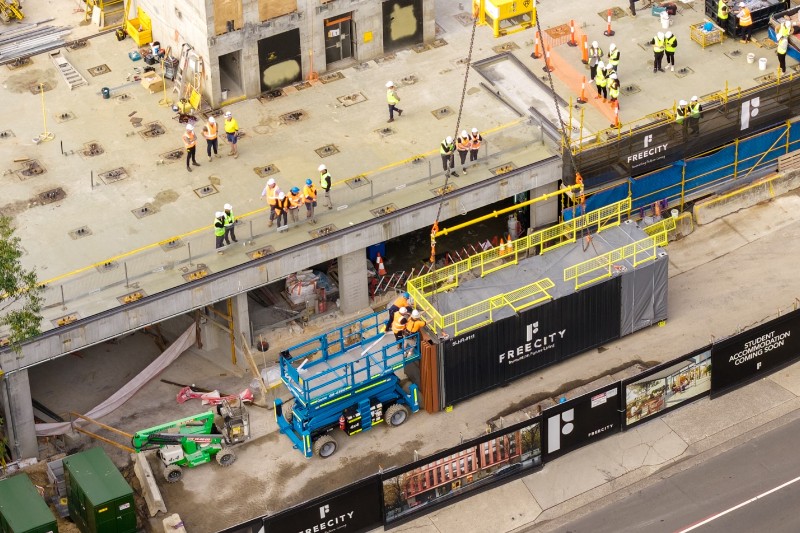
While much of the discussion surrounding Freecity’s 528-bed Herring Road student accommodation project has focused on the decision to manufacture volumetric modules offshore, company executives argue that the more important story lies in how those modules are delivered, certified and integrated into an Australian construction environment. (main image: A volumetric module is craned into position at Freecity’s Herring Road student accommodation project in Sydney.)
For Freecity, the decision to source manufacturing overseas was not driven by a desire to avoid local production. Rather, it reflected the realities of delivering large-scale volumetric projects in a market where manufacturing capacity, project volume and investment certainty remain closely linked.


According to Space Labs General Manager Angus Kell, the objective was never simply to manufacture modules offshore.
Instead, the focus was on securing the manufacturing capability required to deliver projects, recognising that the Australian market is still developing the scale, capacity and project pipeline needed to support large-volume volumetric manufacturing.
The approach has allowed Space Labs, Freecity’s wholly owned modular integration business, to focus on design integration, procurement, compliance and project delivery rather than manufacturing ownership.

Offshore manufacturing still means Australian compliance
For Associate Director of Development, Benjamin Brown, one of the most persistent misconceptions surrounding offshore manufacturing is that compliance standards somehow change once production moves beyond Australia.
“You’re still complying with Australian Standards and you’re still complying with the NCC,” Brown said.
“What changes is the level of rigour.”
That rigour begins long before manufacturing commences.
For Herring Road, design practitioners, building practitioners, consultants and project stakeholders were involved in reviewing designs, assessing materials and verifying compliance pathways before production approval was granted.
Because volumetric modules arrive substantially complete, many decisions traditionally resolved during construction must instead be addressed during design and manufacturing.
The result is a process that places greater emphasis on front-end planning, documentation and coordination.
Every component comes under scrutiny
According to Kell, one of the least visible aspects of the project has been the compliance review process required before manufacturing could begin.
“There are about 165 materials, fittings and fixtures in every module,” Kell said.
“Every single one of those materials has been through a compliance review before manufacturing starts.”
The assessment process extends across structural systems, finishes, fixtures, services and product certifications.
Brown said the exercise has required significant effort from the development team, consultants and certification specialists, but it has also helped establish processes that can be applied across future projects.
Rather than being viewed as a one-off exercise, the work undertaken on Herring Road is helping create a framework for future developments.
Finance remains a significant hurdle
While compliance is often the focus of discussions around offshore manufacturing, both Brown and Kell identified project finance as another challenge facing wider adoption.
According to Kell, many lenders remain cautious because they have limited experience assessing completed volumetric projects.
“Banks are reticent at the moment because they want to see exemplary projects,” Brown said.
“Once you put two or three projects on the ground, we’re confident they’ll become more comfortable with the model.”
Brown believes the issue is often one of familiarity rather than risk.
“Most finance organisations aren’t saying no because they believe the risk is too high,” Kell said.
He argues that many financiers are still building an understanding of how volumetric projects are delivered and assessed.
Building a framework for future projects
For Freecity, one of the most significant outcomes of Herring Road may be the systems and processes established during delivery.
The project has required the developer, its consultants, certifiers and delivery partners to establish compliance, certification and procurement processes that can be applied to future volumetric modular developments.
According to Brown, that work is expected to become increasingly important as additional projects move through the company’s pipeline.
As future projects progress, Freecity expects the systems, compliance pathways and procurement processes established through Herring Road to help streamline delivery across subsequent developments.