
Please turn your device to portrait.

A proposed business category for Australia’s offsite construction sector.
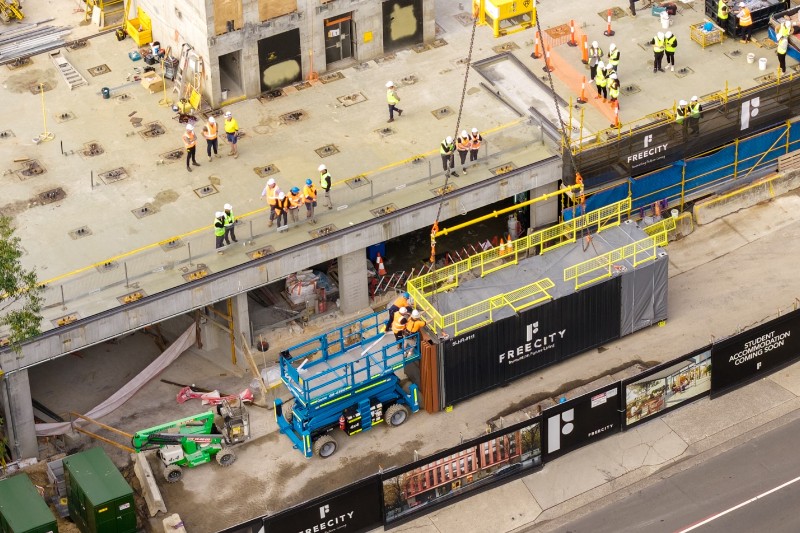
Australia’s offsite industry has manufacturers, builders and developers. This article proposes a new business category for organisations that assume commercial responsibility for integrating multiple stages of project delivery under a single commercial model. (Main image: A volumetric module is craned into position at Freecity’s Herring Road student accommodation project in Sydney, supplied through its modular integration business, Space Labs Australia.)
Australia’s offsite sector encompasses a wide range of business models. Some companies design and deliver complete buildings. Others specialise in manufacturing industrialised building systems or prefabricated building elements, supplying builders, developers and contractors who retain responsibility for project delivery.
All of these businesses play an important role in Australia’s construction ecosystem.
Yet a growing number of organisations no longer fit neatly into these established categories. Rather than simply manufacturing products or constructing buildings, they assume commercial responsibility for coordinating multiple stages of project delivery while drawing on the capabilities of specialist designers, engineers, manufacturers, installers and suppliers.
The industry does not yet have a widely recognised term for this type of organisation.
Perhaps it needs one.
For the purposes of this discussion, these organisations can be described as industrialised building integrators.
This is not intended to describe a particular construction methodology. Whether a company manufactures volumetric modules, panelised systems, prefabricated building elements or complete buildings is almost secondary. What distinguishes these organisations is that they assume commercial responsibility for integrating the delivery process, providing clients with a single point of responsibility for programme, quality, cost and financial accountability.
Why integration matters
While Australia’s offsite sector continues to mature, much of the discussion has focused on manufacturing capability—factory automation, digital engineering and production efficiency.
Increasingly, however, developers, institutional investors and government agencies are looking beyond manufacturing towards delivery certainty.
Every additional interface between designers, manufacturers, transport providers, installers, contractors and consultants introduces another layer of coordination, contractual complexity and commercial risk.
Industrialised building integrators seek to simplify this. Rather than asking clients to manage multiple contracts and project interfaces, they assume responsibility for integrating the delivery process under a single commercial framework.
The scope will differ between organisations. Some may integrate design, engineering and manufacturing, while others extend into procurement, logistics, installation, commissioning or ongoing asset support. What unites them is not a prescribed workflow, but a commercial model centred on accountability.
Existing examples
Businesses operating in this way are already visible, even if they have not been collectively described as a distinct category.
One of the clearest examples is Modulmatik. Originally established as a modular timber manufacturer, the Vienna-based business deliberately evolved beyond manufacturing after concluding that its greatest value lay not in factory ownership, but in engineering coordination and systems thinking. As co-founder Michael Doroshenko explained, “Our greatest value was organisation and systems thinking.”

Today, Modulmatik positions itself less as a manufacturer and more as an engineering and systems company, coordinating modularisation strategy, engineering, production logic and distributed manufacturing across multiple manufacturing partners rather than relying on a single factory.
Australia is also providing examples. Rather than establishing its own modular factory, Freecity created Space Labs Australia, a wholly owned modular integration business responsible for coordinating design, compliance, procurement, manufacturing, logistics and delivery across its volumetric modular pipeline. The business was established because Freecity concluded that volumetric modular construction required a different delivery model, positioning Space Labs between the developer, consultant team, builder and manufacturer as a single point of coordination.
These examples demonstrate that the defining characteristic is not ownership of a particular factory or proprietary building system. It is the ability to integrate expertise, supply chains, manufacturing capability and project delivery within a single commercially accountable framework.
Watch Freecity’s volumetric modular buildings being manufactured by its production partner.
Why this distinction matters
Industrialised building integrators do not replace manufacturers, builders or developers. Rather, they provide a useful way of describing organisations that assume commercial responsibility for integrating project delivery across multiple stages of construction.
Importantly, they are also system-agnostic. Whether a project incorporates volumetric modular, panelised timber, light gauge steel, prefabricated building elements, precast concrete or future systems such as System 600, the objective remains the same: selecting and integrating the most appropriate solution for the project.
Should initiatives such as System 600 achieve broad national adoption, this role could become even more significant. Standardised building systems have the potential to simplify integration across multiple suppliers, allowing organisations to focus less on promoting individual products and more on delivering measurable project outcomes.
Perhaps the greatest contribution industrialised building integrators could make is strengthening the evidence base for industrialised construction itself. By taking responsibility for project delivery rather than individual products, they would be well placed to measure programme certainty, productivity, quality, cost, carbon performance and operational outcomes across different industrialised construction systems.
That evidence could help governments, developers, financiers and policymakers compare delivery models on the basis of measurable outcomes rather than individual product claims. In doing so, industrialised building integrators could help shift the industry’s focus from advocating for particular construction systems to demonstrating the broader value of industrialised construction.
If the term proves useful, industrialised building integrators may become more than a new business category. It could provide the industry with a common way of describing organisations that integrate delivery, while helping build the commercial and evidentiary framework needed to support the broader adoption of industrialised construction in Australia.