
Please turn your device to portrait.

Hong Kong introduces a modular construction master standard with Australian industry participation, US manufacturer BOXABL discloses financial uncertainty, and Finland develops a prefabricated structural system for timber apartment construction.
Hong Kong launches modular construction master standard with Australian industry participation
Hong Kong has launched its first Modular Integrated Construction (MiC) Master Standard and Guidebook, advancing efforts to establish common modular construction standards across the Greater Bay Area.

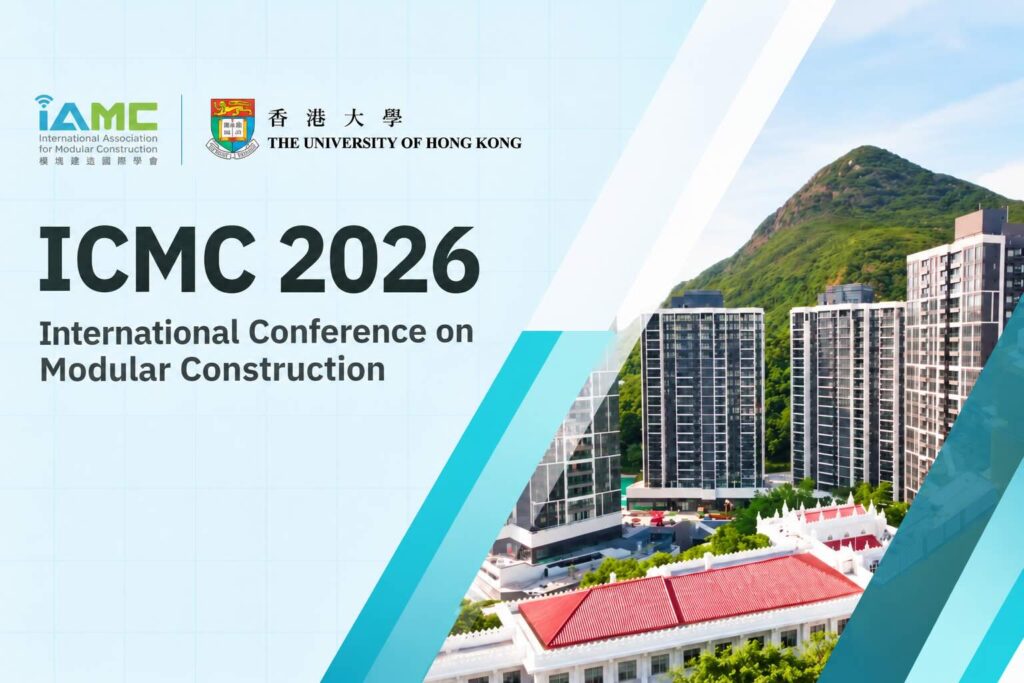
Announced on 21 November at the International Conference on Modular Construction, the initiative follows an agreement between Hong Kong and Guangdong Province to jointly develop construction standards, with implications for international markets sourcing prefabricated building modules from the region.


Australia was represented at the conference by Professor Tuan Ngo, Research Director and Board Director of prefabAUS and Research Program Lead at Building 4.0 CRC, and Gabriel Solorzano Torres, Project Leader of the National Centre of Excellence for Future of Housing Construction at Melbourne Polytechnic.
Their participation comes as Australia progresses the development of national regulatory pathways for prefabricated and modular construction, alongside initiatives to develop workforce and manufacturing capability.
Hong Kong’s Secretary for Development, Bernadette Linn, confirmed that more than 150 modular construction projects have been completed or are underway across Hong Kong.
The government has also established a manufacturer accreditation scheme to support quality assurance and reserved approximately 30 hectares of land for a high-end construction industry park.
Significantly, Linn identified Australia, alongside Africa and the Middle East, as a market where interest has been expressed in building modules produced by Hong Kong-accredited manufacturers.
Find the ICMC 2026 event HERE (Editor’s note: This link will be updated when the MiC Master Standard and Guidebook is available online.)
US manufacturer BOXABL warns over financial viability
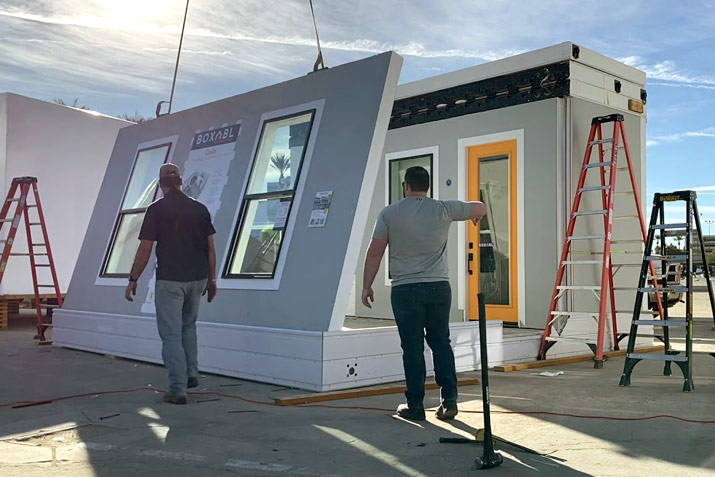
US prefabricated housing manufacturer BOXABL has disclosed substantial doubt about its ability to continue as a going concern in its quarterly financial report to the US Securities and Exchange Commission (SEC).
The Nasdaq-listed company reported a net loss of US$35.9 million (approximately A$55 million) and an operating cash outflow of US$24.9 million (approximately A$38 million) for the nine months ending 30 September 2026.
Unrestricted cash declined from US$29 million (approximately A$44.5 million) at the end of December 2025 to US$14 million (approximately A$21.5 million) at the end of September.
The company held 198 completed Casita homes and a further 190 units classified as work in progress. During the nine-month reporting period, BOXABL fulfilled orders for 36 Casita units and manufactured 54 new units.
BOXABL attributed delays in delivering completed homes partly to customer site readiness, including permitting, feasibility studies and land preparation.
Management is seeking to reduce operating costs, accelerate housing deliveries and sales, and raise additional capital through equity financing.
Find the SEC quarterly financial report HERE and Boxable HERE
Finnish prefabricated system targets timber apartment construction
The system incorporates factory-finished separating walls and intermediate floor elements, with the development partners targeting construction time reductions of up to 10 per cent.

It incorporates Metsä Wood’s Kerto-Ripa laminated veneer lumber (LVL) wall and floor elements, alongside connection technology developed by A-Insinöörit for Würth.
The developers report that separating walls can be up to 30 per cent thinner and intermediate floors between 10 and 20 per cent thinner than conventional timber construction systems, increasing usable floor area within the building envelope.
During a pilot project at a timber apartment development in Kirkkonummi, installation of the wall and floor elements associated with one apartment was completed in less than an hour.
The system also transfers much of the work associated with acoustic ceiling construction from the building site to the factory.
Further information HERE (Finnish)








