
Please turn your device to portrait.

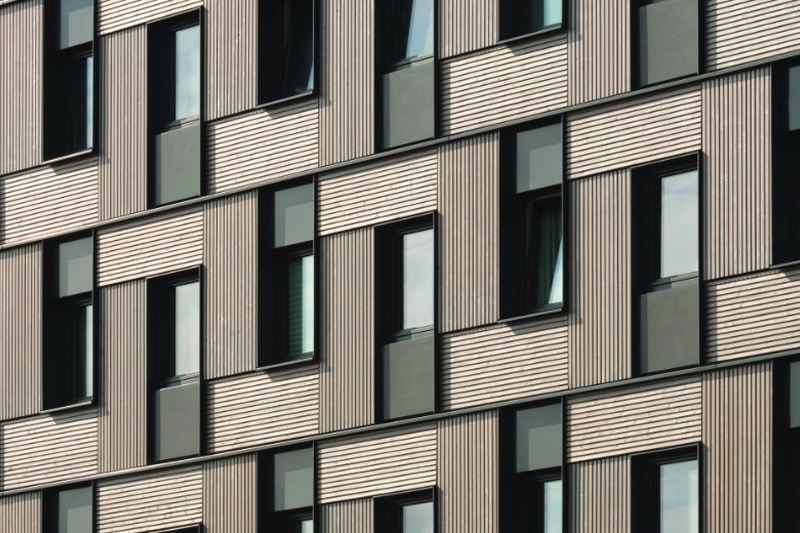
Kaufmann Bausysteme relocates timber module production closer to major construction projects and explores international licensing of its manufacturing system.
Austrian modular construction company Kaufmann Bausysteme has developed an alternative to the conventional fixed-location manufacturing model, establishing temporary production facilities close to major construction projects rather than transporting completed volumetric modules over long distances.
The approach allows the company to establish production facilities in rented industrial buildings within three weeks, with the necessary manufacturing equipment transported in six trucks.
The strategy emerged following Kaufmann’s first major school project in Berlin, which involved more than 400 timber modules. Transporting completed modules from its manufacturing facility in Kalwang, Austria, was deemed economically unviable, prompting the company to establish production operations in Berlin.
The approach was subsequently replicated in Rostock, northern Germany, after Kaufmann secured a contract for a customs school involving approximately 1,000 modules.
Rather than constructing dedicated factories, Kaufmann identifies existing industrial buildings with sufficient floor space and overhead crane capacity. Local workers and subcontractors are recruited, with the company’s construction and project management teams providing initial training and production support.
When a manufacturing facility is no longer required, its production infrastructure can be dismantled within a week.
The company operates manufacturing facilities in Kalwang, Berlin and Rostock, with a combined production area of 17,000 sq m and annual manufacturing capacity of up to 4,000 timber modules. Design and planning operations are centralised at its headquarters in Reuthe, Austria.

Digitising the manufacturing process
Central to Kaufmann’s manufacturing model is a proprietary digital system that documents individual production tasks and establishes consistent manufacturing procedures across its facilities.
Modules move along rails through successive workstations, where workers undertake prescribed assembly and fit-out tasks. The production line is reported to deliver one completed module per hour, with prefabrication levels reaching up to 95 per cent.
Each module is assigned a QR code linking its design and manufacturing information, while individual production stages are documented photographically within the company’s digital system.
Kaufmann Bausysteme’s three module types – closed, semi-open and open – accommodate individual rooms and larger communal spaces, with a flexible dimensional grid guided by transport logistics rather than fixed module sizes.

Cross-laminated timber (CLT) is the principal structural material, with prefabricated timber components delivered to the respective manufacturing facilities for assembly.
Kaufmann manufactures three principal module configurations: closed, semi-open and open. Module dimensions can be adapted to individual project requirements rather than being restricted to a fixed dimensional grid.
In December 2025, managing director Christian Kaufmann reported annual CLT requirements of approximately 40,000 cubic metres and forecast production of more than 3,000 modules during 2026.
The company had completed 35 schools in Berlin over the preceding six years and secured a framework agreement for a further ten schools valued at €400 million (approximately A$712 million).
More recently, Kaufmann delivered the German federal president’s temporary headquarters in Berlin, an 18,700 sq m, six-storey building incorporating 382 prefabricated timber modules. The modules were manufactured at its Berlin-Herzfelde production facility.
Exporting manufacturing expertise
Kaufmann is also exploring a franchise model through which its manufacturing expertise and digital production systems could be licensed to overseas construction businesses.
The company has already supported a modular construction project in Montana, United States, providing its digital production tools and deploying personnel to assist with establishing a local manufacturing facility.
Kaufmann has reportedly also received enquiries from New Zealand and is exploring a franchise model based on licence fees for each module manufactured.
While international licensing represented only a small proportion of the company’s revenue in December 2025, Kaufmann identified it as an area for further business development.
Find Kaufmann Bausysteme HERE









