Please turn your device to portrait.

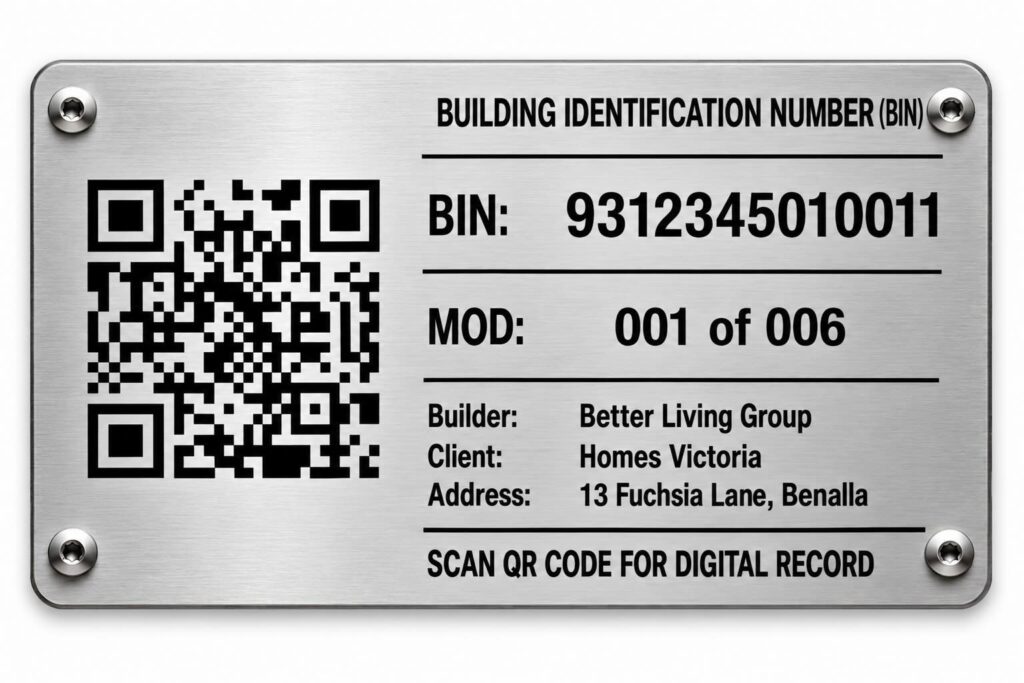
An industry-led pilot involving 50 modular homes in Victoria will test whether a permanent Building Identification Number can improve construction traceability, progress payments and access to finance.
Australia’s prefabricated construction sector is testing a proposed building identification system designed to address one of modular housing’s persistent financing challenges: verifying the value and progress of homes while they are being manufactured offsite.
National peak industry body prefabAUS is leading a pilot of the Building Identification Number (BIN), developed by digital building records company Quipex, with a 50-home modular housing project underway in Victoria providing the initial testing ground.
Modelled on the Vehicle Identification Number (VIN) used by the automotive industry, the BIN would assign buildings and modular components a permanent, verifiable identity from the point of manufacture through to occupation and eventual demolition.

For modular manufacturers, the implications extend beyond asset identification.
Lenders and insurers have traditionally struggled to verify the progress and value of construction undertaken away from the final building site. Consequently, manufacturers often depend on alternative security arrangements to finance factory production.
The proposed BIN would establish a digital chain of custody documenting manufacturing milestones, materials, compliance and ownership-related information. It would also complement the recently introduced prefabAUS Class 1 contract, which provides for progress payments during factory construction.
“Modular and offsite construction is under constant pressure from lenders and insurers to prove what has actually been delivered and when. A verified building identifier is exactly what our industry needs,” said Damien Crough, co-founder and executive chairman of prefabAUS.
Testing the financial and technical case
The initiative brings together representatives from Commonwealth Bank, GS1 Australia, Geoscape, RMIT University, Better Living Group, Dulux and James Hardie, alongside prefabAUS and Quipex.

Under the proposed arrangement, GS1 identification standards would provide scannable identifiers during manufacturing, subsequently linked to Geoscape’s location and address records.
Bonnie Ryan, general manager of Industry Engagement at GS1 Australia, said established global identification standards could provide the framework needed to maintain consistent building information across the construction supply chain.
“A building identifier delivers the greatest value when it operates within a globally recognised data standards framework. GS1 identification standards already enable trusted product, asset, and materials data to move efficiently across supply chains around the world,” Ryan said.
RMIT University will evaluate material traceability, embodied carbon documentation and the system’s potential to reduce financing risks.
Quipex chair Graeme Samuel AC said the inability to independently verify modular units during factory production remained a barrier to conventional lending.
Quipex chair Graeme Samuel AC said the inability to independently verify modular units during factory production remained a barrier to conventional lending.

“Banks and insurers price risk, but where they cannot identify and verify an asset, they are often not prepared to price it at all. That is the position with a modular home while it is being built in a factory,” Samuel said.
“Lenders do not generally take the unit as collateral during construction, because they cannot see it, track it or verify what has been built. Builders and manufacturers then have to secure their funding against other assets.”
Samuel said the pilot would test whether verified identification and a documented chain of custody could change how financial institutions assess modular construction.
“The pilot will test whether giving each modular unit a verified identity and chain of custody, from the factory floor to occupation, allows lenders and insurers to assess whether they could treat it as collateral and then to price the risk in a far more granular way.”
Commonwealth Bank is also examining potential applications for progress payments on commercial and multi-residential developments.
If the pilot demonstrates that independently verified factory-built components can be recognised as financeable assets, it could provide a mechanism for improving manufacturer cash flow and supporting the wider adoption of modular construction in Australia.