Please turn your device to portrait.

Triggered by a looming skills deficit by 2030, construction firms are starting to express interest in prefabrication construction robotic technology to address not only the imminent skills shortage but to also address workplace safety, reduce onsite waste and improve quality.
It’s generally acknowledged that robotics in automation offers significant potential to enhance productivity, efficiency and manufacturing flexibility throughout the construction industry, including automating the prefabrication of modular homes and building components offsite, robotic welding and material handling on building sites, and even extending to 3D printing of houses and customised structures.
“With so few construction businesses using automation today, there’s huge potential for us to transform the industry through robotics. Unlike building cars or assembling electronics, many techniques used in construction haven’t changed for generations, so we are developing new solutions to address key industry challenges,” said Sami Atiya, President of ABB’s Robotics & Discrete Automation Business Area.
“This new customer segment will broaden our portfolio as part of a wider strategy to accelerate expansion in high-growth segments including electronics, healthcare, consumer goods, logistics and food and beverage, to meet the growing demand for automation across multiple industries.”
In a recent global survey commissioned by ABB of 1900 large and small construction businesses in Europe, the US and China, 91 percent said they face a skills crisis over the next 10 years, with 44 percent saying they struggle to recruit for construction jobs.
Improving health and safety on building sites was a priority for 42 percent and the same percentage said the environment is a key driver for industry change.
81 percent of construction businesses said they will introduce or increase the use of robotics and automation in the next decade, while today only a handful of businesses benefit from robotics. In the survey, only 55 percent of construction companies say they use robots, compared with 84 percent in Automotive and 79 percent in Manufacturing.
Industry forecasts for the total value of the global construction industry predict it will rise by 85 percent to $15.5 trillion worldwide by 2030, while ABB Robotics’ internal analysis of the market potential for robotic automation over the next 10 years is for high double digit growth rate in key sectors of construction including prefabrication construction and 3D printing.
Prefabrication construction robots: enabling a new approach
With the construction industry facing increased environmental regulation and the need for more cost-effective buildings, prefabrication construction robotic automation reduces waste by improving quality and consistency, which is significant when it’s estimated that up to a quarter of material transported to a building site leaves as waste. With automation and digital solutions (such as DfMA), builders can also design waste out at the beginning of a project through effective building design and construction processes.
With more than 200,000 vacancies for low and high-skilled workers in the EU alone in Q2 2020, the industry labour shortage is a growing issue, with younger people put off construction careers by perceptions that it is a dangerous occupation. Construction workers account for around 30 percent of workplace injuries and are up to four times more likely to be involved in a fatal accident vs. other sectors, with an estimated 108,000 fatalities every year worldwide.
“A new focus on health, safety and sustainability are catalysts for investment in robotics, while the shrinking pool of skilled labor means the construction industry needs robots to help keep pace with the challenges of urbanization and climate change,” added Atiya.
“We are putting our expertise and industry-leading portfolio of robots and digital tools at the center of the construction industry value chain with automation solutions for faster, more affordable and sustainable construction, while supporting the industry’s labor shortage, by handling large and heavy loads, accessing dangerous spaces and enabling new, safer ways of building.”
Innovation already in use
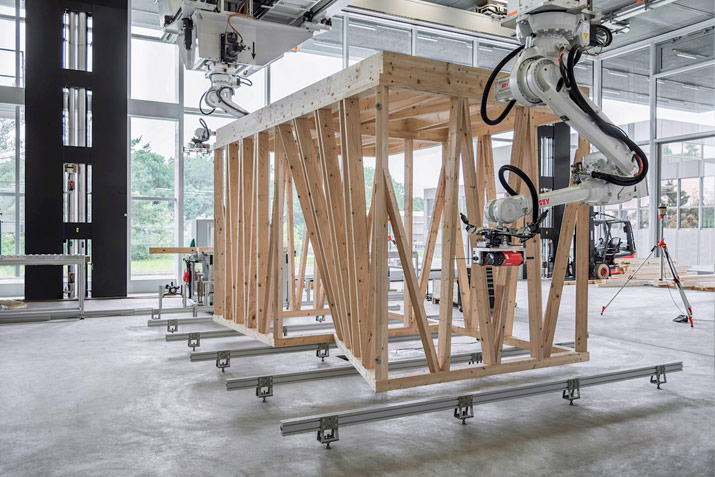
Designed to improve flexibility, productivity and quality, pilot projects include the automated prefabrication of timber roof supports with Autovol in Canada, the robotic installation of elevators with Schindler Lifts and the robotic automation of Intelligent City’s production of prefabricated modular homes, which has increased production efficiency by 15 percent and speed by 38 percent, while reducing waste by 30 percent.
Skanska’s robot welding application has improved quality, employee productivity and safety by automating the fabrication of steel reinforcement baskets on-site. This solution has also reduced the cost and environmental impact of transporting bulky finished reinforcement baskets to building sites.
“It is increasingly challenging to find people to carry out difficult, time-consuming tasks, which means we must look further afield to find the workers we need,” said Ulf Håkansson, Technical Director for Skanska Construction.
“Allocating these tasks to robots can address this, enabling us to deploy our workers more effectively. Automation also suits the experience and imagination of the next generation of engineers, who have grown up with technology and will be invaluable in helping us find new ways to use robots in our business.”
ABB is also working with several leading universities to co-develop new automated construction technologies including ETH Zurich, a leading research university in Switzerland. At ETH, ABB is supporting research in the field of robotics prefabrication in architecture and construction and has helped establish the world’s first laboratory for collaborative robotic digital fabrication in architecture, hosted at the ETH’s Institute of Technology in Architecture.
An ‘Automation and the Construction Industry’ panel discussion will be available to view on their website from this Wednesday.
See: global.abb
Or watch their robots in action here (Robotics prefabrication construction):
Click Here to return to the home page for more articles.