
Please turn your device to portrait.

Where is the modernisation of Australian construction in 2026?
Drawing on more than 50 years in construction, David Chandler AM, former NSW Building Commissioner, sets out why MMC is struggling to gain traction, despite sustained industry advocacy and policy support.

Construction continues on an upward cost trajectory despite MMC. More projects are becoming unfeasible. Market and social housing providers face these headwinds. The opportunities heralded by Modern Methods of Construction (MMC) have fallen short. Business as usual has not changed significantly. It is tough going. Modernisation of the industry appears stalled.
This article focuses mainly on the use of MMC in the multi-unit apartment market. Increasing the supply of social, affordable and market housing continues to confound governments nationally. The use of MMC has been presented as a partial solution. There are many issues.
Offsite construction is not new. Many elements of Australia’s New Parliament House were prefabricated. This enabled the on-site workforce to be limited to 3,000 of the 10,000 involved. There are also strong examples of successful offsite delivery in engineering infrastructure and mining. Complex components, some weighing over 2,000 tonnes, have been successfully designed, manufactured, transported, installed and commissioned over long distances and across multiple markets. The logistics involved, along with the complementary capabilities of transport systems, are notable.
Considerable industry advocacy and public policy effort has been invested in promoting MMC as a pathway forward. Even in offshore markets, where MMC should be showing signs of maturity, the evidence is not compelling. It is timely to examine why offsite, prefab and modular construction in Australia are not achieving wider market acceptance. What are the root causes behind the limited uptake of approaches that promise faster, better, cheaper and more sustainable outcomes? The current pipeline of MMC projects has yet to provide convincing evidence that these outcomes are being achieved or are achievable.
I have spent over 15 years engaging with prefab across the Australian and New Zealand markets. Overseas study tours often return with enthusiasm for factory-based construction and the adoption of digital and automated (robotic) fabrication. Participants highlight increased factory workflows, reduced waste and high-precision production, with tolerances of plus or minus 2.5mm. What leaves the factory appears impressive, as do the assemblies presented on site. Far less attention is given to on-site realities, including failures and their consequences. That said, I remain an advocate for modern construction.
Where are the fault lines and how do they impede modernising our industry?
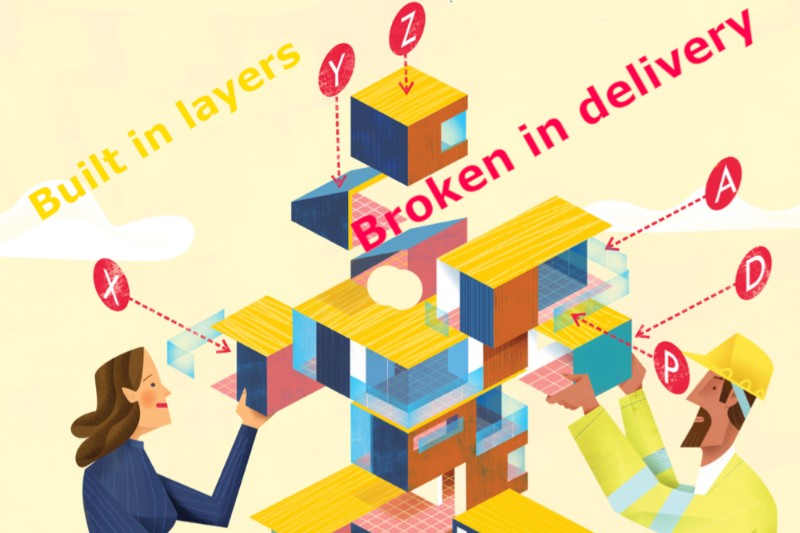
We need to examine the end-to-end systemic issues that fragment a modern approach to construction. There are no simple solutions, but understanding the technical and transactional interfaces required to support new delivery models is a necessary starting point. Without this, the same fault lines will persist.
UNSW has announced a new short course aimed at equipping construction and legal professionals with the procurement, regulatory and dispute mitigation expertise required to deliver offsite construction. A link to theLegal Essentials for Off Site Construction is provided HERE. It is the first course of its type in Australia. Participants will undertake pre-reading to enable informed contribution and discussion.
One of the pre-readings is New York Tech’s discussion paper Handshake to Hardware (PDF). It explores key questions and pathways towards a uniform law and commerce framework for North American offsite construction. The course targets mid-career practitioners.
Handshake to Hardware is a timely contribution. It examines a system designed for bespoke buildings and artisanal trades, and explains how business as usual has become a structural obstacle to innovation in an era of modular assemblies, offsite fabrication and industrialised building processes. The paper argues that the AEC industry’s reliance on common law service contracts is inhibiting the development of a national Configure to Order (CTO) marketplace for building components, which is standard practice in most manufacturing sectors. The authors propose how a Uniform Commercial Code (UCC) could evolve to reflect a built environment increasingly delivered through offsite manufacturing.
The paper also considers how building components move through fabrication, assembly, transport and installation, crossing multiple legal regimes — initially governed as goods and ultimately as real property. These are important considerations. See related commentary: Construction doesn’t resist change – it prevents it and Path dependence – history shapes outcomes.
Australia’s public and private sector procurement systems create misalignments
Embedded risk aversion is evident at every stage of procurement. The integrity of buildings delivered under these conditions is being tested.
An example is currently unfolding in Queensland, where QBuild’s $426 million modular housing project is experiencing the consequences of supply chain discontinuity, defects and remediation. Early reports point to issues including water damage, black mould contamination, structural failures, material degradation, failed finishes and sequencing problems. It is suggested that up to 120 modules may be sent to landfill. Reports of transportation damage add to these concerns. The full picture will take time to emerge.
prefabAUS has reported that responsibility for the failure lies with the on-site contractor, FCC. It stated: “Modscape (the fabricator) were contracted to deliver modules to site. FCC were contracted to install the modules and put a roof on the building.”
Modscape have been issued a variation to supply another 300 modules, like for like. prefabAUS said: “Let’s hope FCC put a roof on the building this time, as they are contracted to do. Modscape did offer to undertake that scope, but FCC declined. It is preferable that we do not provide inaccurate or speculative information.” Only time will reveal the underlying fault lines.
A regional councillor’s observations offer a more direct account of site conditions. Queensland’s Housing Minister has suggested that issues of this nature can occur on large projects. The cost of 120 discarded modules may be close to $52 million. This represents a significant portion of Housing Australia’s $206.25 million contribution to one of Queensland’s largest social and affordable housing developments, intended to deliver 490 dwellings in Cairns.
Projects of this nature, both large and small, risk undermining confidence in prefab. The issues identified may prompt reconsideration of how MMC projects are procured and delivered.
Where to from here?
MMC has yet to demonstrate consistent progress in the Australian construction market. Rising costs and delivery delays continue to affect project feasibility. Offsite construction costs appear to be normalising residential delivery above $7,000 per square metre.
This creates increasing challenges for residential purchasers. Current approaches to MMC are unlikely to reverse this trend without structural change. Costs must reduce.
For now, UNSW’s short course on the Legal Essentials for Off Site Construction provides a forum where the technical and transactional issues can be translated to support future MMC.