
Please turn your device to portrait.


Singapore’s digital building approval reforms put government at the centre of construction productivity. For Australia’s prefabrication sector, they raise an uncomfortable question about public procurement and the slow adoption of industrialised construction.
Singapore has decided that digital coordination in construction is no longer something best left to individual companies. It is becoming a regulatory requirement.
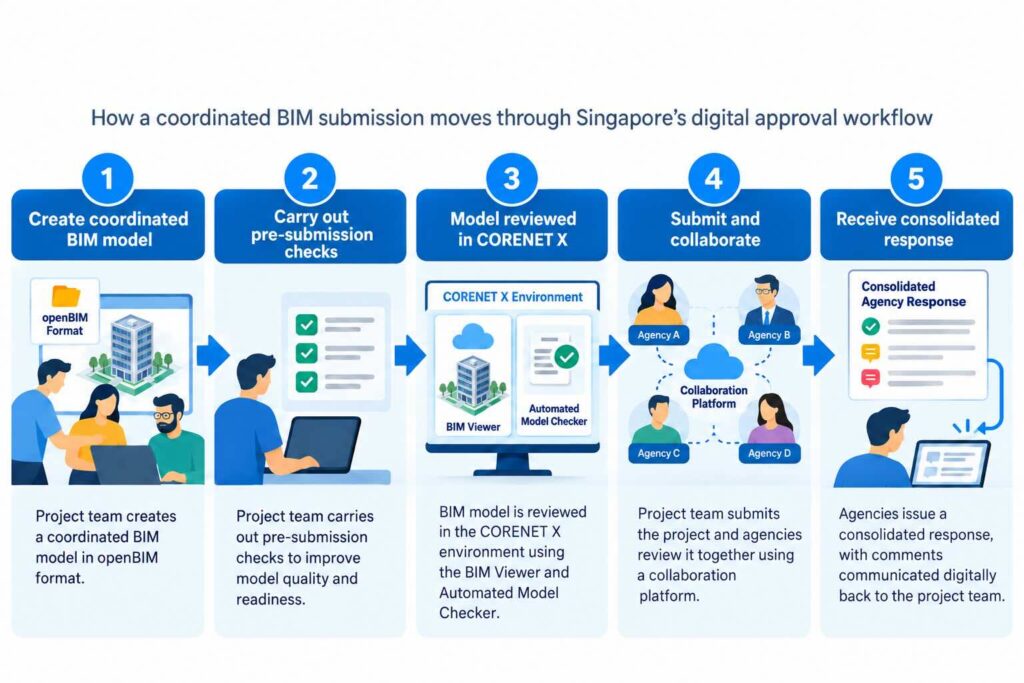
From 1 October 2026, new developments of 5,000 square metres or more must use CORENET X, a digital building approval platform requiring coordinated three-dimensional Building Information Modelling (BIM) submissions.
It is a significant change in how buildings are designed, assessed and approved. And it raises an obvious question for Australia: why does government continue to talk about construction productivity without making greater use of the considerable influence it already has over how buildings are procured?
Singapore’s reforms are not simply about replacing drawings with digital models.
Led by the Building and Construction Authority (BCA) and Urban Redevelopment Authority (URA), with support from GovTech, CORENET X requires registered architects and professional engineers to coordinate their designs before submitting them for regulatory approval.
Rather than preparing separate versions of building plans for different authorities, project teams develop and review coordinated BIM models, identifying design conflicts before they become construction problems.
The system has been developed with government agencies and industry, and its Code of Practice includes provisions for documenting Design for Manufacturing and Assembly (DfMA), manufactured components and standardised building systems.
That matters because prefabrication cannot simply be introduced halfway through a conventionally designed building project and expected to deliver its promised efficiencies.
Manufacturing depends on decisions made early: dimensions, tolerances, interfaces, repeatability and the coordination of structural and building services systems. Get those decisions wrong and the advantages of factory production can quickly disappear.
Singapore is not mandating prefabrication. But it is requiring a level of digital coordination that supports the disciplines on which industrialised construction depends.
Government procurement remains an underused lever
Australia’s situation presents a different, but related, problem.
Governments are among the country’s largest construction clients. Their purchasing decisions influence how projects are designed, tendered and delivered. Yet public procurement frequently follows processes established around conventional construction, with little explicit requirement to investigate manufacturing-led alternatives.
The Australian Government’s recent Defence accommodation procurement illustrates the opportunity. Programmes involving large numbers of repeatable buildings would appear natural candidates for assessing modular and prefabricated construction. But unless that assessment is required early, the opportunity can be lost before contractors submit their bids.
None of this requires governments to prescribe modular buildings or abandon conventional construction.
It requires them to ask better questions earlier, demand coordinated design information and require proponents to demonstrate whether industrialised delivery has been properly considered.
Singapore has recognised that government can change industry behaviour by changing the rules under which it operates.
Australia has the same capacity, both as a regulator and as a major construction client.
The question is whether it intends to use it.