
Please turn your device to portrait.

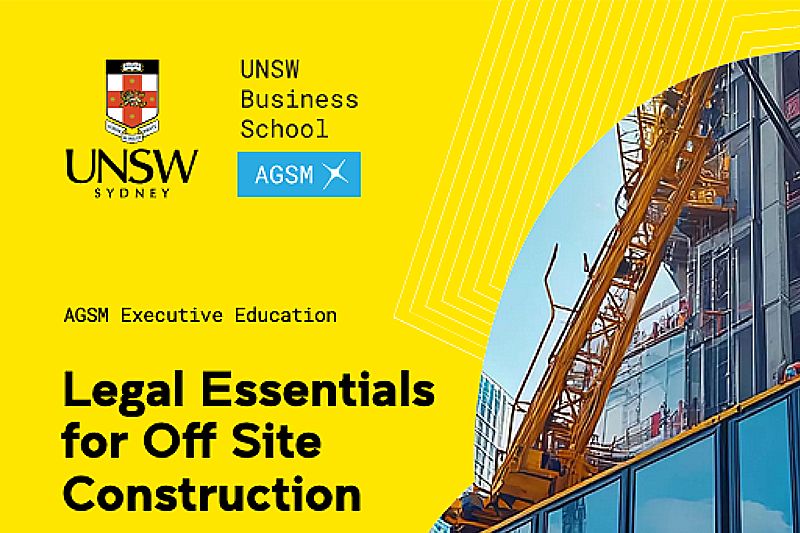
Course examines procurement structures and interface risk in offsite delivery.
When: 14 May 2026 (duration two days)
Where: UNSW Sydney (in-person)
Book: HERE
The UNSW Business School has introduced a new short course, Legal Essentials for Offsite Construction, aimed at addressing a growing gap between modern construction methods and the legal frameworks used to procure and deliver them.
Scheduled for 14 May in Sydney, the two-day, in-person programme is designed for senior professionals working across development, manufacturing, engineering and legal advisory roles. It focuses on how offsite construction reshapes risk allocation, contract structures and regulatory oversight compared to traditional delivery models.
Legal risk moving upstream in offsite projects
The course arrives as modular and prefabricated construction continues to scale, bringing increased scrutiny to how projects are structured and delivered. Recent project challenges, including those involving Modscape in Cairns, have drawn attention to the coordination required between factory output and on-site construction. In that case, a supply-only contract clarified that responsibility for installation and weather protection sat with the head contractor, reinforcing how risk is distributed across project participants.
While not a legal precedent, the situation highlights the practical consequences of interface risk and procurement structure in large-scale modular projects.
By contrast, recent case law has begun to define how courts assess those risks when disputes arise. The NSW Court of Appeal decision in Larsen v Tastec Pty Ltd (No 2), left undisturbed by the High Court, confirmed that loss may be assessed by the cost of rectification rather than changes in market value. In that matter, a variation to a specified cladding system led to damages of $483,244, with the Court finding that the relevant loss was the removal of a contractual entitlement.
Together, these developments point to a shift in how risk is both managed in practice and interpreted in law, with greater emphasis on early-stage procurement, specification and variation decisions.
Watch Carrie Metcalfe, Program Director, explain the course.
Course structure and delivery
The UNSW programme is structured around these conditions. Delivered over two days, it combines legal analysis, case studies and applied discussion.
Day one focuses on procurement and regulatory frameworks, including contracting structures, interface risk, design responsibility and title transfer, alongside legislative considerations such as the Design and Building Practitioners Act and security of payment regimes.
Day two addresses more complex issues, including international supply chains, importation risk and dispute positioning within modular construction environments. Residential and industrial case studies are used to test these concepts in practical scenarios.
Participants complete pre-course work, with in-person sessions supported by facilitated discussion and structured peer learning.
Watch David Chandler OAM introduce the course.
Delivered by legal and industry practitioners
The course is directed by Carrie Metcalfe, a former partner at MinterEllison. The faculty brings together legal, regulatory and industry expertise, including David Chandler, alongside practitioners such as David Glinatsis, Richard Crawford and Mark Glynn.
Further legal and project delivery perspectives are provided by William Vu, Nicole Sawick and Kai Smith. Industry input is incorporated through Steven Mann, reflecting the interface between legal frameworks and project delivery.
The programme positions legal capability as a core component of offsite construction, focusing on how procurement decisions, contractual structures and regulatory interpretation shape project outcomes from the outset.